Goodbye “Robotic Voice” and “Localization Challenges”: Laaffic’s Self-Developed SKTTS Technology Reshapes Voice Experiences in Global Gaming Marketing
In global gaming marketing, text can be translated, but the “voice” is incredibly hard to disguise.
AI voice is rapidly entering high-frequency scenarios such as customer service, outbound calling, financial notifications, and content production. For high-resource languages like Chinese and English, the industry has already accumulated mature solutions. However, when gaming brands expand into emerging markets in the Middle East, Africa, or Southeast Asia, they immediately encounter a more difficult problem: low-resource languages, regional accents, telephony audio, and mixed code-switching are extremely difficult to handle consistently.
Many generic voice systems can "read out" text, but they cannot express it naturally in a way that local users are accustomed to. Issues such as unstable pronunciation, incorrect reading of numbers and amounts, abrupt handling of English-loaned words, degraded telephony audio quality, mechanical prosody in customer service scripts, and mutual interference between models across different languages directly lower player trust and cause a massive drop in conversion and retention rates.
As a trusted SMS and voice service provider for the Gaming industry, Laaffic knows well: truly effective cross-regional voice engagement is not about reading text stiffly, but speaking in the most natural way for users in the target market. To this end, the Laaffic technical team has self-developed a new generation enterprise-grade AI voice synthesis system — SKTTS. It is not a simple TTS calling tool, but a complete technical system covering text understanding, prosody modeling, acoustic generation, low-resource language adaptation, data governance, quality evaluation, and production deployment. It helps enterprises build deployable localized AI voices with shorter cycles, lower costs, and higher controllability.
Technical Principles: A Self-Developed Closed Loop from Text Understanding to High-Fidelity Voice Generation
SKTTS adopts a self-developed multi-stage neural voice generation architecture, progressively transforming input text into natural, stable, and controllable voice output.
Step one is multilingual text front-end processing. The system performs language identification, text normalization, conversion of numbers and amounts into spoken words, proper noun and industry vocabulary recognition, and mixed code-switching analysis. For low-resource language scenarios, this is particularly crucial, as the same abbreviation or loanword may have completely different pronunciations in different regions.
Step two is semantic and prosody modeling. The system does not pronounce word by word, but predicts pauses, stress, speed, and emotional intensity based on sentence structure, business scenarios, and target language habits, making the voice closer to real communication rather than mechanical reading.
Step three is speaking style and timbre control. It ensures stable output under specified languages, regional accents, voice styles, and business scenarios, forming a consistent brand voice across different use cases.
Step four is self-developed acoustic generation and waveform reconstruction. It focuses on optimizing pronunciation stability in low-resource languages, long-sentence coherence, telephony source robustness, and the naturalness of cross-lingual expressions.
Step five is production-level quality regression. Every model iteration enters a fixed evaluation process, verifying pronunciation accuracy, listening naturalness, timbre consistency, code-switching stability, latency, and failure rates, ensuring that technical upgrades do not break existing language capabilities.
Overcoming Low-Resource Language Challenges: Data Governance and Telephony Audio Optimization
The difficulty of low-resource AI voice lies not just in model capabilities, but in the combined challenges of data, language rules, and real-world business scenarios.
At the data level, SKTTS requires word-for-word alignment between training text and audio. For scenarios in Urdu, Hausa, Swahili, Bengali, etc., the system does not simply rewrite spoken language into formal written text, but preserves real expressions (such as mixed English words and local place names) as much as possible, allowing the model to learn the real language ecosystem. Meanwhile, it prioritizes "less but accurate" over "more but messy," preferring to discard samples with severe noise or text inconsistencies rather than letting poor-quality data pollute the model.
At the audio level, targeting telephony lines (8kHz sampling rate) commonly used in gaming outbound calls, SKTTS has established specialized telephony source processing strategies, including upsampling, bandwidth extension, noise control, and scenario layering. This preserves the real speaking style while significantly improving the clarity of synthesized audio over the phone, completely eliminating the cheap feeling of a "robot chanting."
The Six Core Advantages of SKTTS
1. Fully Self-Developed, Technical Chain and Data Security Controllable
From the acoustic architecture and low-resource language data pipeline to production deployment strategies, everything is independently designed. This means that while gaining high customization flexibility, core voice assets and business data remain in a secure and controllable system.
2. Low-Resource Language Priority, Not an Extension of Mainstream Languages
SKTTS focuses on solving the most common implementation problems in low-resource languages: scarce data, complex accents, numerous business terms, and poor telephony audio quality. It is more suitable for international outbound calling, localized voice bots, and multilingual broadcasting in overseas marketing scenarios.
3. Lightweight Adaptation Engine, Rapid Market Entry
It adopts a "unified voice generation system + multilingual adaptation modules" architecture. Enterprises do not need to maintain massive models for each country; they can quickly establish independent language capabilities as needed, with support for canary releases and continuous optimization.
4. Enterprise-Level Data Governance, Preventing Model Degradation
Every training sample records detailed metadata (channel, signal-to-noise ratio, recognition confidence, etc.). Training sets and validation sets are strictly isolated to prevent data leakage. The rigorous cleaning process is the key foundation for SKTTS to establish stable performance in complex markets.
5. Preserving Real Language Ecosystems (Accents and Code-Switching)
Real players do not always use standard written language. SKTTS preserves the distribution of real "mixed local language and English" through text normalization and sample annotation, making the synthesized voice more acceptable to local players.
6. Evaluable, Regressable, and Deployable
The system does not stop at subjective descriptions like "sounds good" or "natural," but establishes a reproducible evaluation system. Every iteration undergoes fixed sample regression, pronunciation accuracy, timbre consistency, and subjective listening scores, allowing enterprises to clearly judge whether the voice is stable enough for the production environment.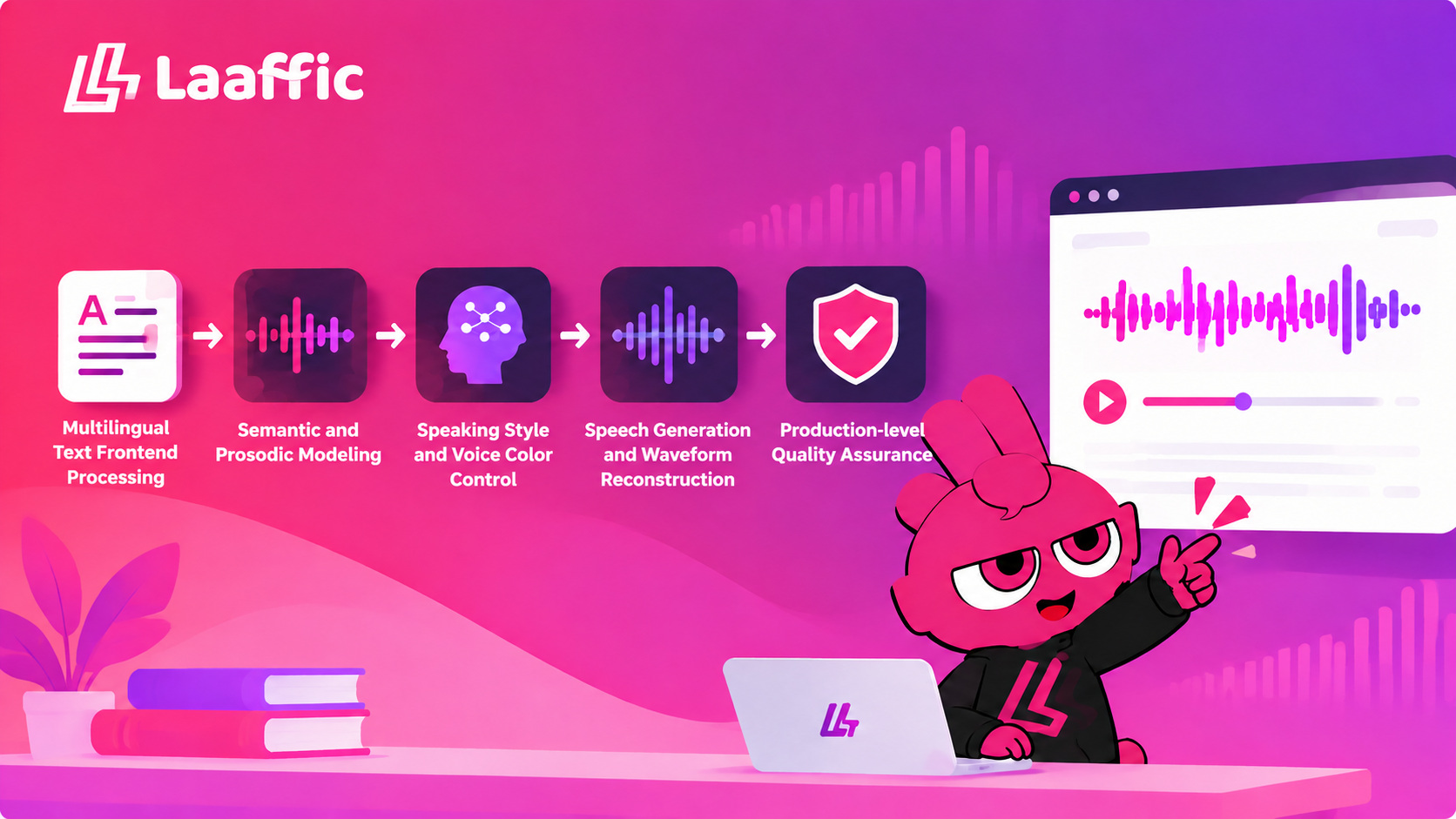
Typical Application Scenarios and Business Value
Combined with SKTTS technology, Laaffic's voice services demonstrate strong business value in the following overseas gaming marketing scenarios:
-
Intelligent Customer Service and VIP Follow-ups: Use pure local accents for billing reminders, identity verification, and after-sales follow-ups. Localized voices lower the distance between users and significantly increase answer rates.
-
Efficient Dormant Player Reactivation: Say goodbye to mechanical group calls. Use natural, emotionally rich local voices combined with Laaffic's post-call SMS to effectively reawaken players' enthusiasm for the game.
-
Cross-Regional Market Expansion: When entering diverse markets like the Middle East and Latin America, there is no need to hire overseas voice actors at high costs. Generate high-quality multilingual marketing audio quickly, supporting parallel expansion across multiple markets.
-
Education and Content Production: In localized in-game tutorials, audiobooks, or short video dubbing, significantly reduce recording costs and increase content update speed.
Turning low-resource languages from cost centers into growth entry points. SKTTS standardizes and modularizes low-resource language voice production, allowing enterprises to cover new markets faster and form a continuously accumulating corporate voice asset.
Frequently Asked Questions (FAQ) About SKTTS
Q1: What is the difference between SKTTS and traditional generic TTS (Text-to-Speech) systems?
A: Traditional TTS is mainly optimized for high-resource languages like Chinese and English, often resulting in stiff pronunciation and monotonous accents when facing low-resource languages. SKTTS is a fully self-developed system by Laaffic, adhering to a "low-resource language-first" principle from the beginning. It specifically solves implementation challenges in low-resource languages, such as scarce data, complex accents, and mixed local-English expressions (code-switching). The generated voice is more in line with the real communication habits of local users.
Q2: Why does SKTTS perform better in gaming telephony outbound call scenarios?
A: Gaming outbound calls usually use telephony lines with an 8kHz sampling rate, and directly applying conventional voice models can cause muffled sound. SKTTS has specifically developed telephony source processing strategies (upsampling, bandwidth extension, and noise control) to maintain clarity, stability, and high robustness even over phone lines, significantly improving the player's listening experience.
Q3: What business value does introducing SKTTS bring to gaming brands expanding into overseas markets?
A: SKTTS standardizes and modularizes low-resource language voice production. It allows gaming enterprises to quickly launch authentic localized voices without spending high costs and long cycles hiring overseas voice actors when entering markets in the Middle East, Africa, or Southeast Asia. This not only reduces construction costs but also directly empowers user reactivation and conversion by enhancing player trust, turning language capabilities into a growth entry point.
Q4: How does Laaffic ensure data security and privacy during the voice generation process?
A: As a trusted SMS and voice service provider for the Gaming industry, Laaffic always puts data security first. We not only have rigorous enterprise-level data governance standards but have also obtained ISO 27001 (Information Security Management) and ISO 27701 (Privacy Information Management) international certifications. This means that clients' core business data and voice assets are protected by the highest international standards during both development and deployment.
Conclusion
Generic TTS solves the problem of "how text becomes sound." SKTTS solves the problem of "how enterprises can continuously produce trustworthy, compliant, natural, and deployable low-resource language AI voices."
Let every language have a high-quality AI voice, and let every local market be heard naturally, accurately, and reliably. No matter which region your gaming business expands to, Laaffic's SKTTS can help you bridge the language gap, making every voice engagement the beginning of player trust.


